
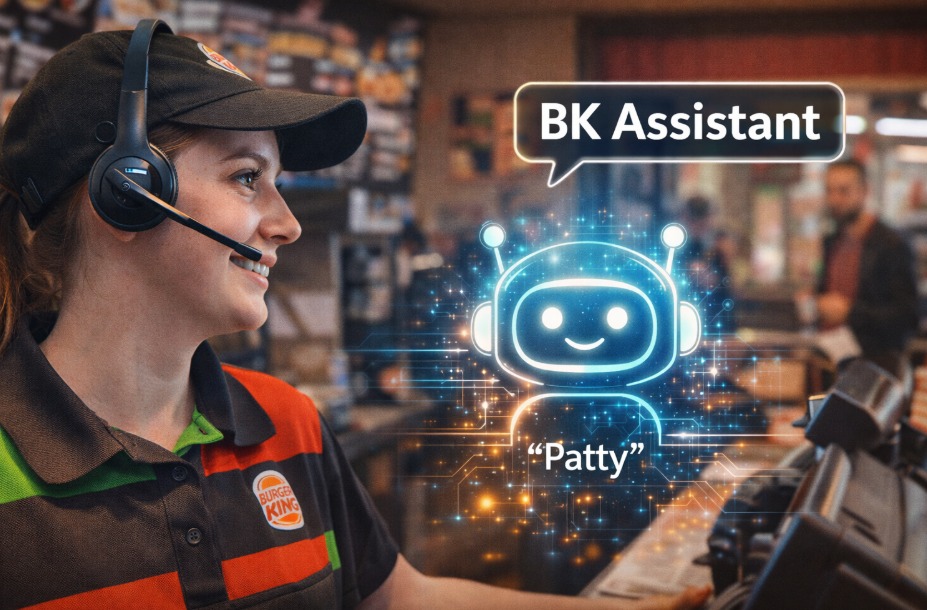
Burger King is rolling out an artificial intelligence chatbot designed to assist staff and analyse customer interactions, including whether workers use polite phrases such as “please” and “thank you”. The move, currently under way in the United States, has sparked criticism online and raised fresh questions about workplace surveillance in the fast-food sector.
The system reflects a broader trend of global hospitality chains adopting AI tools to improve efficiency and customer service, developments that could eventually extend to UK high streets and retail parks.
AI chatbot ‘Patty’ to assist Burger King staff
Burger King announced on Thursday that it is introducing a new AI-powered platform called BK Assistant to hundreds of its US restaurants. The system includes a voice-enabled chatbot, named “Patty”, which connects to employee headsets.
Powered by technology from OpenAI, the developer behind ChatGPT, the assistant can detect specific words used during customer interactions, including greetings and polite expressions such as “welcome”, “please” and “thank you”.
According to Burger King, the aim is to help managers “understand overall service patterns” and support restaurant operations.
The exaggeratedly cheerful “customer service voice” has long been a familiar feature of hospitality work, often joked about in British and American popular culture alike. Burger King’s system effectively attempts to quantify elements of that interaction using AI.
Company denies monitoring individual staff performance
The announcement triggered a backlash on social media, with critics describing the technology as intrusive and emblematic of excessive corporate oversight.
However, a Burger King spokesperson sought to clarify the system’s purpose.
“It is not designed to track nor evaluate employees saying specific words or phrases,” the spokesperson said.
“BK Assistant is a coaching and operational support tool built to help our restaurant teams manage complexity and stay focused on delivering a great guest experience.
“It’s not about scoring individuals or enforcing scripts. It’s about reinforcing great hospitality and giving managers helpful, real-time insights so they can recognise their teams more effectively.”
Wider AI functions include order accuracy and kitchen support
Beyond monitoring speech patterns, the BK Assistant platform includes a range of operational features.
The system can automatically alert managers to remove unavailable items from digital menus and the Burger King mobile app, reducing the risk of customers ordering out-of-stock products.
It can also guide kitchen staff through food preparation. For example, once a Whopper order is received, the AI can remind employees of the correct ingredients and assembly process.
According to company materials, the assistant can even notify staff when facilities such as toilets require cleaning.
Additionally, the platform listens to drive-through conversations to improve order accuracy and provide coaching feedback.
Such systems are seen by companies as a way to streamline operations and reduce costly errors, particularly during busy periods.
Rollout underway across the United States
Burger King said the headset-based system is currently being tested in around 500 restaurants across the US. The company plans to expand the platform to all its American locations by the end of 2026.
While there has been no announcement of a UK launch, the chain operates hundreds of restaurants across Britain, and global technology rollouts often reach UK franchises after initial trials overseas.
The introduction comes amid mixed results for AI in fast-food drive-throughs.
In 2024, rival chain McDonald’s abandoned its own automated AI ordering system after trials at more than 100 locations, following reports of errors and customer frustration.
Growing debate over AI in the workplace
The use of AI tools to monitor service interactions reflects wider changes across sectors including retail, call centres and logistics, where employers are increasingly using software to measure performance and efficiency.
Supporters argue such systems can improve training and consistency, while critics warn they risk eroding trust and increasing pressure on frontline workers.
In the UK, unions and workplace experts have already raised concerns about surveillance technologies, particularly where they may affect employee wellbeing or job security.
Conclusion
Burger King’s introduction of an AI assistant capable of analysing staff interactions highlights the growing role of artificial intelligence in everyday service jobs. While the company insists the tool is designed to support rather than monitor workers, the backlash illustrates ongoing unease about how far employers should go in using AI to oversee human behaviour. As the technology evolves, similar debates are likely to emerge in Britain and beyond.

Thomas Hawthorne is a contributor to Nintendo-power.com, covering a broad range of topics including news, business, technology, entertainment, lifestyle, and current affairs. He focuses on delivering clear, accurate, and accessible reporting that helps readers stay informed about important developments and emerging trends. With a reader-first approach, Thomas aims to provide useful context, balanced insights, and engaging stories that reflect the issues, events, and interests shaping everyday life.