
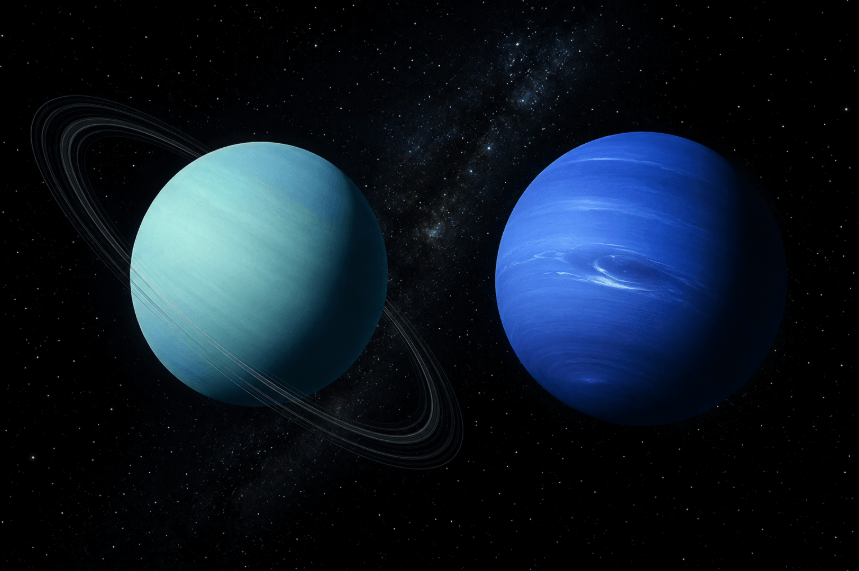
Uranus and Neptune have long been classified as the Solar System’s two ice giants, but new research suggests their interiors may be far more complex than previously believed. Scientists now propose that these distant planets could contain vast magma oceans beneath their atmospheres, challenging decades of assumptions about their composition and evolution.
As some of the least explored planets in the Solar System, Uranus and Neptune remain scientific mysteries. Both worlds have only been visited once, during flybys by NASA’s Voyager 2 spacecraft, leaving many questions about their internal structures unanswered.
New Research Challenges Long-Held Theories
For decades, planetary scientists have believed that Uranus and Neptune possess thick hydrogen-helium atmospheres surrounding extensive layers of water, ammonia and methane ices, with rocky cores at their centres. This model led to their classification as ice giants, distinguishing them from the larger gas giants Jupiter and Saturn.
However, a new study published on the arXiv preprint server and submitted to the Astrophysical Journal suggests the traditional picture may not tell the full story.
Researchers from the University of California, Los Angeles (UCLA) used advanced computer simulations to investigate the internal composition and processes of both planets. Their goal was to test whether existing ice giant models accurately explain the observed characteristics of Uranus and Neptune.
Unusual Features Remain Difficult to Explain
Although conventional models have been widely accepted, they have struggled to account for several puzzling observations. In particular, the planets’ unusual magnetic fields and heat distribution patterns have remained difficult for scientists to explain.
The UCLA team sought to determine whether an alternative internal structure could better match these observations.
The researchers also highlighted the broader significance of the work. Understanding Uranus and Neptune could provide valuable insights into sub-Neptune exoplanets, which are among the most common types of planets discovered beyond our Solar System.
These planets typically range between one and 4.5 times the radius of Earth. Because no similar world exists close to home, astronomers have limited opportunities to study such planets directly, making Uranus and Neptune important natural laboratories.
Evidence Suggests Vast Magma Oceans
According to the study, the interiors of Uranus and Neptune may contain magma oceans rather than the icy layers traditionally proposed.
The model developed by the researchers suggests that each planet still possesses a hydrogen-helium atmosphere that transports heat upwards before releasing it into space. Beneath this lies a boundary layer containing hydrogen, helium, magnesium, silicon monoxide and oxygen.
A New Interior Structure
At greater depths, the study proposes a vast magma ocean composed of silicates, iron and hydrogen.
This structure could potentially explain several observed properties of Uranus and Neptune while also drawing parallels with the composition of sub-Neptune planets found around other stars.
The researchers wrote in their conclusion: “While this is just one of a number of models that successfully reproduce the observed features of Neptune and Uranus, this model has several aspects to recommend it. One is the connection with other gas dwarf planets; it is not clear that ice giants and sub-Neptunes should be fundamentally different simply because of their distances from their host star.
“Related to this is the fact that the most basic chemical features of the ice giants resemble those of gaseous sub-Neptunes, perhaps indicating similar boundary conditions for the chemistry of the atmospheres imposed by the magma oceans.”
Future Missions Could Provide Answers
Despite their scientific importance, Uranus and Neptune have received little attention from spacecraft since Voyager 2’s historic visits.
Several future mission concepts have been proposed, including the Uranus Orbiter and Probe (UOP) and Neptune Odyssey. The UOP concept would deploy a probe into Uranus’s atmosphere while an orbiter studies the planet and its moons. Neptune Odyssey would similarly enter orbit around Neptune to investigate the planet and its satellite system in greater detail.
Neither mission has yet been approved, but scientists hope future exploration could provide the data needed to determine the true nature of these distant worlds.
A Fresh Look at the Solar System’s Outer Planets
The new findings add another layer to the ongoing debate over what lies beneath the clouds of Uranus and Neptune. If the magma ocean model proves correct, it could reshape scientists’ understanding of the two planets and offer important clues about the formation of the many sub-Neptune worlds found across the Milky Way.
For now, the theory remains one of several competing explanations, but it highlights how much remains to be discovered about the Solar System’s most distant giant planets.

Thomas Hawthorne is a contributor to Nintendo-power.com, covering a broad range of topics including news, business, technology, entertainment, lifestyle, and current affairs. He focuses on delivering clear, accurate, and accessible reporting that helps readers stay informed about important developments and emerging trends. With a reader-first approach, Thomas aims to provide useful context, balanced insights, and engaging stories that reflect the issues, events, and interests shaping everyday life.