
Google’s A-series smartphones have long aimed to deliver flagship-style software and photography at a more accessible price. The Pixel 10a continues that approach, arriving as a £400-to-£500-class handset designed for everyday users rather than technology enthusiasts chasing cutting-edge upgrades.
Yet reviewing the Pixel 10a involves balancing two very different perspectives. On one hand, it may be one of the best mid-range smartphones currently available. On the other, it represents one of the most incremental upgrades Google has released in recent years. For most buyers, however, what matters is simple: does it deliver value for money?
Design and Hardware
A Refined, Practical Look
The Pixel 10a’s design closely mirrors its predecessor, the Pixel 9a, but with a few welcome refinements.
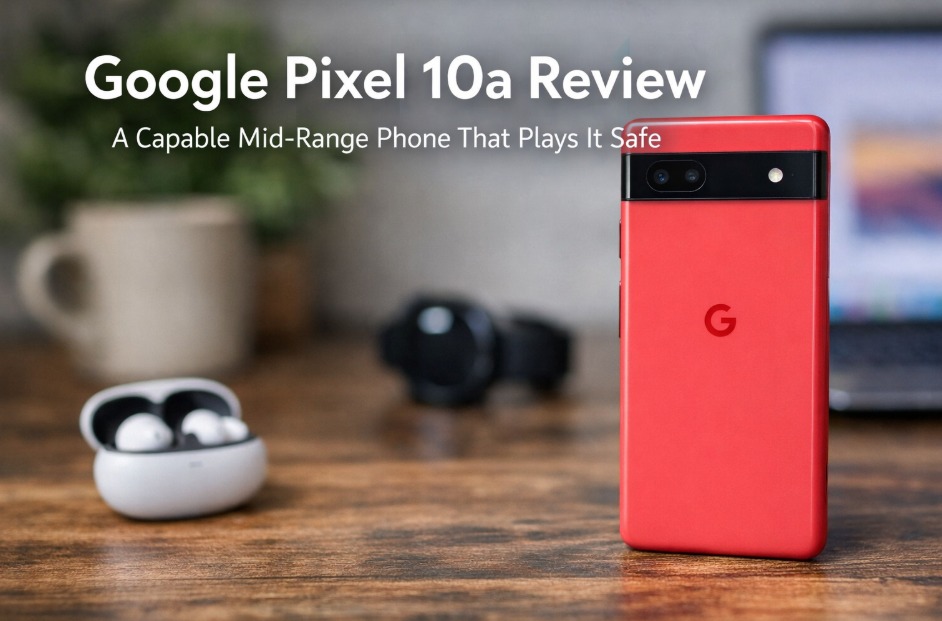
Google has removed the raised camera border, opting instead for a slightly thicker chassis that sits flat on a table. The result is a phone that no longer rocks when placed on a desk — a small but practical improvement for everyday use.
The flat, balanced design evokes the clean lines of earlier smartphones, even recalling the aesthetic of Apple’s iPhone 4 era. In a smartphone market that can often feel visually repetitive, the understated look feels surprisingly refreshing.
A new berry colour option stands out in particular. Its bright tone calls back to the iconic red Nexus 5, one of Google’s most recognisable devices from the mid-2010s. It is not identical, but it remains one of the most distinctive colour finishes currently available.
Elsewhere, the handset keeps its matte finish across the entire body — something oddly unique to the A-series, as Google’s flagship Pixels still mix glossy and matte surfaces.
Slimmer Bezels, Balanced Weight
Google claims to have reduced the display bezels by around 10 per cent compared with the Pixel 9a. The difference may only measure a millimetre, but in daily use it helps the phone feel noticeably more modern.
The device’s weight distribution is also well balanced, avoiding the top-heavy feel found on some flagship phones. Despite a 9mm thickness, the flat camera design helps the handset feel slimmer than its measurements suggest.
Display, Performance and Specifications
A Strong Display for the Price
The Pixel 10a’s display is almost identical to the panel found on the standard Pixel 10. Colours are vibrant, brightness is strong and Google’s Adaptive Tone feature adjusts the display to match ambient lighting conditions.
One meaningful hardware improvement is the introduction of Gorilla Glass 7i. Previous A-series models relied on the far older Gorilla Glass 3, so the upgrade provides improved durability and a smoother feel under the finger.
The only minor irritation is an occasionally over-reactive auto-brightness system, though it appears to settle after a few days of use.
Tensor G4 and Everyday Performance
Powering the phone is Google’s Tensor G4 processor — the same chip used across the Pixel 10 lineup.
It is not new technology, but it remains perfectly adequate for everyday tasks such as messaging, social media, streaming and web browsing. Only the most demanding mobile gamers are likely to push it to its limits.
The handset also includes Google’s Exynos 5400 modem, enabling satellite SOS functionality — a feature becoming increasingly common on modern smartphones.
With 8GB of RAM, performance is smooth in day-to-day use. However, given Google’s promise of seven years of software updates, some users may wonder whether that memory capacity will remain sufficient further down the line.
Small Downgrades From the Pixel 10
A few compromises separate the Pixel 10a from its flagship sibling.
The stereo speakers are noticeably weaker, particularly when listening to podcasts or video. Haptic feedback is also less refined than on the Pixel 10, and the optical fingerprint sensor can be overly bright when unlocking the phone in a dark room.
None of these issues are deal-breakers, but they collectively explain the price difference between the models.
Software and Battery Life
Android 16 With Google’s AI Tools
The Pixel 10a runs Android 16 with Google’s familiar Pixel interface, offering one of the cleanest software experiences available on any smartphone.
Many of Google’s AI features are included, although a few advanced tools — such as Magic Cue and Pixel Screenshots — are reserved for higher-end devices.
For some users, the lighter AI approach may actually be welcome. Most of the more advanced features rely on cloud processing anyway, meaning the everyday experience remains largely unchanged.
Google’s setup process, interface design and Material 3 Expressive styling continue to set a high standard across the Android ecosystem.
Battery Life That Easily Lasts a Day
Battery performance is a strong point.
With mixed use — including messaging, social media, web browsing, YouTube and podcasts — the Pixel 10a comfortably lasts more than a full day. Lighter usage can stretch that to nearly two days.
Charging speeds are modest. The device supports 30W wired charging, reaching around 50 per cent in roughly 30 minutes. Wireless charging has increased to 10W.
One disappointment is the absence of Qi2 magnetic charging support, which would have enabled compatibility with magnetic accessories similar to Apple’s MagSafe system.
Camera Performance
Still Excellent for the Price
The Pixel 10a uses the same camera hardware as the Pixel 9a, meaning there are no major improvements this year.
In good lighting conditions, the camera produces sharp images with the balanced HDR style that Pixel devices are known for. However, performance drops noticeably in darker environments, and digital zoom beyond 2x quickly loses detail.
Even so, the Pixel 10a still delivers one of the best camera experiences available on a sub-£500 smartphone.
The challenge is that computational photography improvements have slowed across the Pixel lineup in recent years. Images remain reliable, but the dramatic leaps seen in earlier Pixel generations are no longer as obvious.
Verdict: Excellent Value, Even If It’s Not Exciting
The Pixel 10a is not a revolutionary smartphone. In fact, its biggest weakness may simply be how little it changes from the model before it.
Yet judged purely on its own merits, it remains an excellent mid-range device. It offers a well-balanced design, dependable performance, strong battery life and one of the best cameras available at its price.
Shoppers who find discounted deals on older Pixel models — such as the Pixel 9, Pixel 9a or Pixel 10 — may still prefer those options. However, for buyers looking for a reliable everyday phone without flagship pricing, the Pixel 10a delivers a complete and dependable experience.
The modern smartphone market may lack the excitement it once had, but devices like the Pixel 10a prove that reliability and value are now just as important.

Thomas Hawthorne is a contributor to Nintendo-power.com, covering a broad range of topics including news, business, technology, entertainment, lifestyle, and current affairs. He focuses on delivering clear, accurate, and accessible reporting that helps readers stay informed about important developments and emerging trends. With a reader-first approach, Thomas aims to provide useful context, balanced insights, and engaging stories that reflect the issues, events, and interests shaping everyday life.