
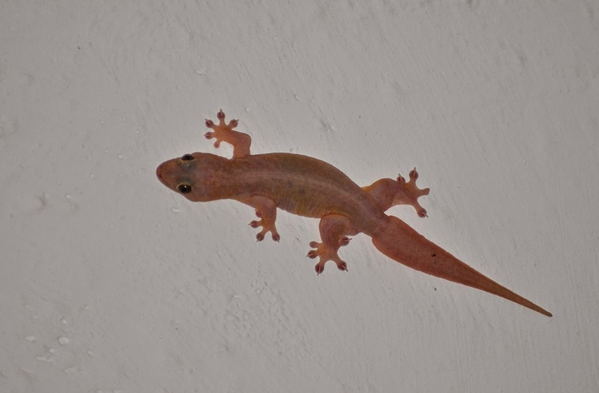
Everyone knows the gecko in Reunion. or Margoillat, as it is called here. And his extraordinary ability to move upside down, glued to the ceiling.
American scientists have succeeded in unraveling this mystery. It has been known for years that the tips of the legs of geckos have millions of setules, elastic fine hairs, arranged in a specific order and ending in a spatula shape.
This microstructure allows the marcoil to follow the shape of the surface on which it moves.
Using X-ray microscopy, researchers at NIST (American National Institute of Standards and Technology) discovered that setulae and their spatulae are covered in a greasy film one nanometer thick, one billionth of a meter.
These lipids play an important role in protecting tissues against dehydration, due to their hydrophobic nature. By repelling any water molecules, they give off spatulae “Intimate contact with the surface”Tobias Veitne, a chemist at the Danish Aarhus University and co-author of the study, was quoted in a press release from NIST and reproduced by the journal. good morning. Full “May Help Geckos Stick to Wet Surfaces”According to him.
Researchers are now considering applications for this discovery in everyday life. How about non-slip boots on wet floors or gloves capable of holding wet tools? However, further studies are still necessary to determine precisely the benefits of this fatty film.

Edward Langley is a contributor to Nintendo-power.com, covering a wide range of topics including news, business, technology, entertainment, lifestyle and current affairs. He focuses on delivering clear, balanced and accessible reporting that helps readers stay informed about important developments and emerging trends. With an emphasis on accuracy, relevance and useful insights, Edward aims to provide engaging stories and practical information that matter to audiences in the UK and beyond.