
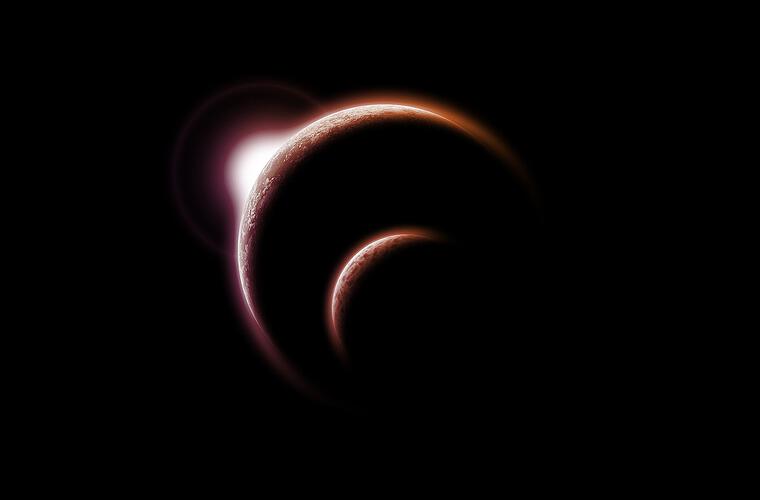
- New planet discovered: Exoplanet Glycy 486 b 26 light years away
- Integrates the properties of the planetary atmosphere Earth and Venus
- Short distance is considered serious for the first time Observing a strange situation Permission
- Researchers speak for themselves “The stroke of luck”
Over the past two and a half decades, astronomers have discovered numerous spacecraft made up of gas, ice, and rock. With the advent of efficient exoplanet hunting facilities, the number of newly discovered worlds outside the solar system quickly rose to thousands. Sometimes researchers talk about the discovery of 24 Earth-like planets, the living conditions of which are sometimes better than our home planet. Another time a student discovered 17 new planets. But only a few planets are actually like Earth. What we really know about them is often based on indirect observations and explanations. Beautiful representations of hilly planetary landscapes under two suns, They are shown by NASA, Come from the artist’s imagination rather than difficult scientific facts.
New planet discovered: a view of a strange atmosphere
Researchers are now re-reporting Trifon Trifonov from the Max Planck Institute of Astronomy About the discovery of a hot super-Earth orbiting the red dwarf star Clichy 486, “only” 26 light years away. The short distance for astronomers should enable better observations in the future, and tell us how it really is on the planet. Even so, observations at a distance of 26 light years are difficult. Translated to Earth, it looks like you want to notice a pin from the North Pole to the South Pole.
Order the telescope to get started from Amazon
What makes the planet Glyce 486b so special is that despite its short distance from its parent Sun, it may still be part of its original one. Atmosphere Holds. It is therefore well suited for the study of its gas casing and its interior with next-generation space and ground-based telescopes.
By combining various observation techniques, astronomers have also determined planetary masses, sizes and mass densities, which allow them to estimate their internal structure. But this information only allows for indirect conclusions about the uniqueness of the planets. The next challenge is to fully classify extraterrestrial planets such as Earth by studying their atmospheres..
Especially on rocky planets like Earth, such an atmosphere consists of only a thin layer. For this reason, many of the current atmospheric models of rocky planets remain untested.
Glycy 486b: A combination of Earth and Venus
Planetary atmospheres must meet certain requirements to be observed with next-generation laboratories. Only 26 light-years away, scientists in the CARMENES consortium (Collar Aldo are searching for high-resolution M dwarfs with near-infrared and optical Échelle Spectrographs with the Exoorts) have now discovered a planet orbiting the red dwarf star Glyce 486. Named the newly discovered planet Glycy 486b is a super earth With one Mass, The 2.8 times larger Like our home planet. He too 30 percent larger than Earth.
“The proximity of this Exoplanet is exciting because it can be explored very closely by powerful telescopes such as the upcoming James Webb Space Telescope and the Future Large Telescope,” explains Tryphon Trifonov. He is a Max Planck Institute for Astronomy (MBIA) and a planetary researcher. Lead author of the article introducing this finding.
If one calculates the average density of the planet from the determined masses and radii, it turns out that it has a similar structure to Venus and Earth, including a metal center. Anyone who wants Glyce 486b will love it Gravity Feel it 70 percent strong Than we enjoy in our home world.
Glycy 486b orbits one of its parent stars Roundabout Inside 1.5 days And in one 2.5 million kilometers away. A rotation around its own axis takes a long time, so that one side always faces the star. Although the glycemic 486 star is much fainter and colder than the Sun, the radiation is more intense, at least on the planet’s surface. 700 Kelvin (Approximately 430 C). In that sense, the surface of Glycyrrhiza 486b is more Venus-like than Earth, with hotter and drier terrain being crossed by glowing volcanic currents. Under these conditions the life we know from the earth is impossible.
Researcher: “Discovery of Glycy 486b is a godsend”
Unlike Venus, Glyce 486b may have only a thin atmosphere. Sample calculations may agree with both conditions because the radiative atmospheres from the stars evaporate. At the same time, the planet’s gravity helps maintain it. It is difficult to determine a balance between these two contributions.

Edward Langley is a contributor to Nintendo-power.com, covering a wide range of topics including news, business, technology, entertainment, lifestyle and current affairs. He focuses on delivering clear, balanced and accessible reporting that helps readers stay informed about important developments and emerging trends. With an emphasis on accuracy, relevance and useful insights, Edward aims to provide engaging stories and practical information that matter to audiences in the UK and beyond.