
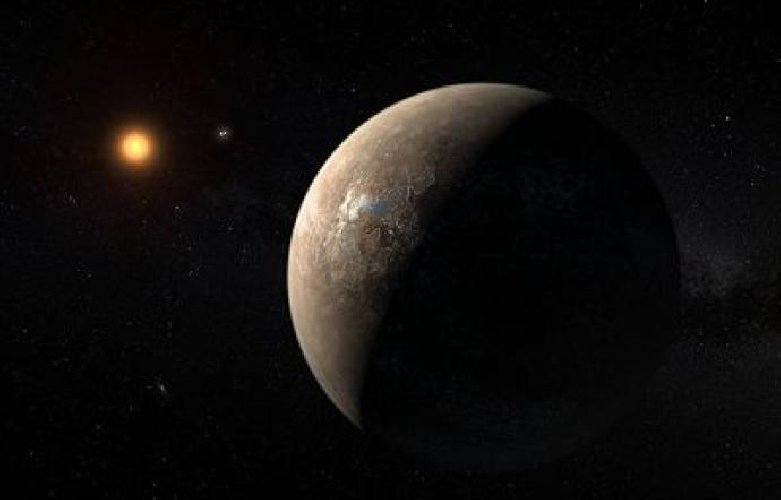
Catania – Radio signals such as Earth’s polar auroras are for the first time linked to the intense magnetic activity induced by the planet Proxima-B, which orbits the star Proxima Centauri, 4.2 light-years away. Researchers led by the Andalusian Astronomical Society (IAA) and radio astronomers from Catania’s National Astronomical Institute (ENAF) captured radio signals related to the planet’s contact with its parent star.
Details are outlined in the journal Astronomy and Astrophysics. One of the authors of the study, Korato Trigilio of the INAF in Catania, explains that “it confirms that even planets outside the solar system are in contact with the magnetic field of their star, and this is important – he adds – extraterrestrial life in search of suitable conditions.” The Proxima Centauri was observed for 17 consecutive days with the Australian Telescope Compact Array (ADCA) Radio Telescope with 6 antennas 22 meters in diameter. Since it fills an entire orbit around its star once every 11.2 days, the Proxima Centauri system is similar to that found on Earth for one and a half years.
Proxima Centauri is a red dwarf 4.2 light-years from Earth: a smaller, cooler and less bright star than the Sun, but experts say it shows intense magnetic activity. Radio emission, astronomers conclude, is due to the proxima-B motion, which produces a beacon effect that is therefore only visible at certain points in the planet’s orbit from Earth.

Edward Langley is a contributor to Nintendo-power.com, covering a wide range of topics including news, business, technology, entertainment, lifestyle and current affairs. He focuses on delivering clear, balanced and accessible reporting that helps readers stay informed about important developments and emerging trends. With an emphasis on accuracy, relevance and useful insights, Edward aims to provide engaging stories and practical information that matter to audiences in the UK and beyond.