

ICRAR astronomers (International Center for Radio Astronomical Research) capture a complete picture of an object’s explosion from a radio broadcast. Black hole The vastness is close to the Earth, and its apparent size (when viewed from Earth) is equivalent to sixteen adjacent moons.
In many science fiction universes, Black holes Inspiration. They are the source of mystery and imagination. One wonders what is “beyond” in particular. Natural astronomy December 23, 2021.
The radio broadcast is fed through a central black hole Galaxy Centaurus A was separated from Earth by about 12 million light-years. This is the radiocalaxy closest to the Milky Way. Seen from Earth, the eruption is equivalent to sixteen moons being placed side by side (which extends eight degrees in the sky).
A disk formed around the black hole
According to Dr. Benjamin McKinley, the captured image reveals spectacular new details from the Centaurus A Galaxy radio broadcast. ⁇ These radio waves come from objects absorbed in the largest black hole in the center of the galaxy. », He explains Was contacted.
⁇ It forms a disk around the black hole, and as it approaches, the material splits, forming powerful jets on either side of the disk, expelling most of the material into space. Light years .
The black hole eats the falling gas and emits matter at speeds close to the speed of light, causing “radio bubbles” to form over hundreds of millions of years. One such “bubble” was captured by the Murchison Whitefield Array Telescope (MWA), located in the interior of Western Australia.
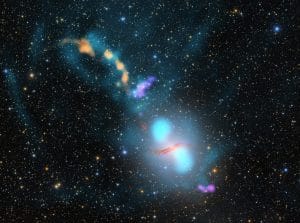
According to the researchers, “previous radio observations could not handle the extreme brightness of jet planes and changed the details of the larger area around the galaxy, but our new image went beyond these limits. Details that allow scientists to” learn a lot about Centaurus A “.
To capture the best picture, the scientists combined their radio observations with optical and X-ray data. It helps to better understand the physics of these gigantic black holes Says McKinley.
MWA can collect “abnormal amounts of data”
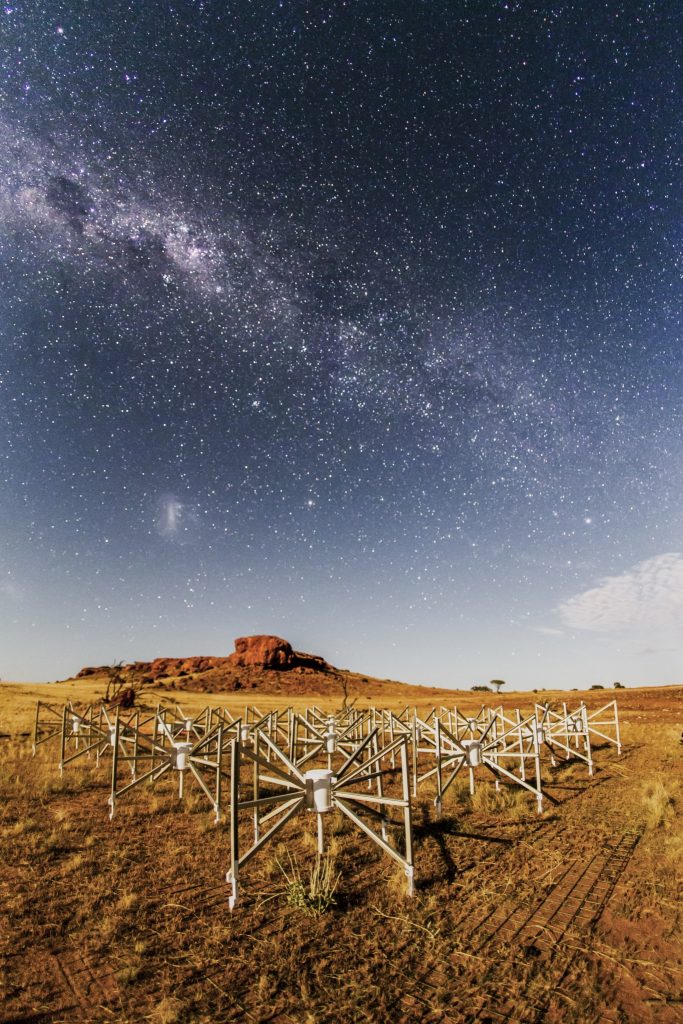
To Professor Steven Dingke, director of the MWA, this observation was made possible by the larger vision of the telescope. MWA is the forerunner of another radio telescope, the more sophisticated SKA (square kilometer line) that is to be built in Western Australia and South Africa.
⁇ The larger the field of view, the more extraordinary data we can collect, the greater the potential for detection of each MWA view. This is a fantastic step towards an even bigger SKA. .
The McKinley-led study confirms a new theory, the increase in the confusing cold. According to Massimo Caspari, an astronomer at the Italian National Institute of Astronomy, ” In this model, cold clouds condense in the galaxy, raining in the central regions, and fueling the largest black hole. .
The galaxy appears brighter in the center, where it is more active and more energetic. When you walk away, the light fades because energy is lost and ” Things calm down », Transparent McKinley. ⁇ But there are some interesting features that make the charged particles accelerate again and interact with strong magnetic fields. , The scientist concludes.
Source: Natural astronomy

Edward Langley is a contributor to Nintendo-power.com, covering a wide range of topics including news, business, technology, entertainment, lifestyle and current affairs. He focuses on delivering clear, balanced and accessible reporting that helps readers stay informed about important developments and emerging trends. With an emphasis on accuracy, relevance and useful insights, Edward aims to provide engaging stories and practical information that matter to audiences in the UK and beyond.