
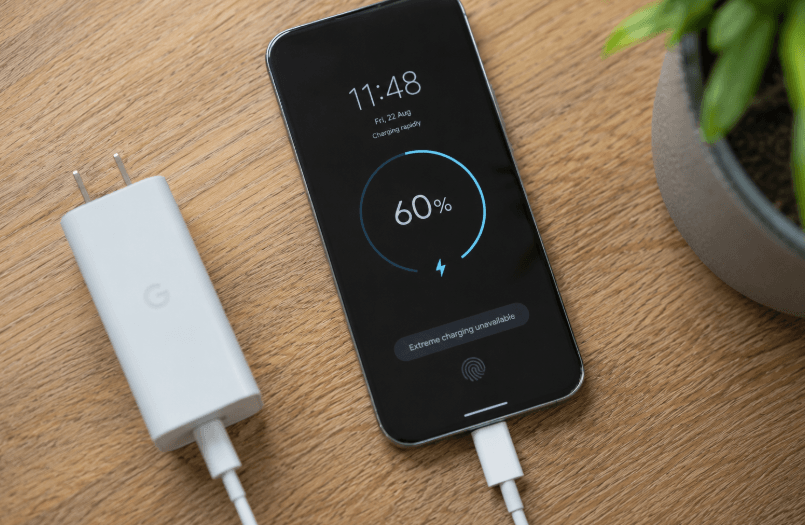
Google has increased the wired charging capability of its latest Pixel flagship, but testing of the Pixel 11 Pro XL suggests the improvement comes with significant compromises. While the handset can approach its advertised 45W charging figure with the right USB-C adapter, strict charger requirements and problems activating the new Extreme Charging feature undermine the upgrade.
Pixel 11 Pro XL Gets Closer to Its 45W Charging Claim
The Pixel 11 Pro XL represents a step forward from previous generations when it comes to peak wired charging power.
Testing with Google’s Pixel Flex 67W charger produced a peak of 40.7W, which was sustained for roughly the first nine minutes. That is an improvement over the approximately 35W peaks observed on the previous two generations of Pixel XL handsets.
Although the phone still falls short of the full advertised 45W figure, maintaining more than 40W for several minutes is a respectable result, particularly when some rival smartphones advertise much higher peak wattages that are maintained only briefly.
However, reaching that level requires compatible charging equipment.
A 21V USB PD PPS Charger Is Required
For optimal Pixel 11 Pro XL charging, users need a USB-C adapter capable of supplying 21V at 2A through the USB Power Delivery Programmable Power Supply, or USB PD PPS, standard.
PPS support itself has become relatively common among modern USB-C chargers sold in the UK, but many existing adapters are limited to around 11V under the protocol. As a result, simply owning a charger rated at 65W or 67W does not guarantee that the Pixel will receive its maximum charging power.
During testing, one 67W PPS charger could supply only 25W to the Pixel 11 Pro XL because it did not meet the handset’s specific requirements.
For consumers, that means the wattage printed on a charger is not enough to determine whether it will provide the Pixel’s fastest available charging speed.
Faster Peak Power Delivers Only Modest Charging Gains
Even with the correct charger, the increased power does not translate into dramatically shorter charging times.
The Pixel 11 Pro XL took approximately 21 minutes to reach 50% and 35 minutes to reach 75%. The Pixel 10 Pro XL took around 23 minutes and 40 minutes respectively to reach the same levels.
Performance is also broadly comparable with the Pixel 9 Pro XL despite the newer handset benefiting from greater peak charging power.
The Pixel 11 Pro XL uses a 5,115mAh battery, slightly smaller than the 5,200mAh unit fitted to its predecessor.
A complete charge was recorded at 69 minutes, an improvement over the Pixel 10 Pro XL’s 81-minute result. However, the test showed a sudden increase from 97% to 100% towards the end of the charging cycle.
Some smartphones report a full battery before charging has completely finished, continuing to trickle-charge afterwards. The behaviour observed on the Pixel 11 Pro XL appears more pronounced than on earlier models, although the final few percentage points are unlikely to make a substantial difference to everyday use.
Extreme Charging Feature Proves Difficult to Activate
Google has introduced Extreme Charging as another way of reducing charging times.
According to the company, the mode allows the handset to charge faster while accepting higher temperatures and potentially reduced device performance during the process.
Google says the Pixel 11 Pro XL can reach 75% battery in approximately 30 minutes when Extreme Charging is active. That would represent a modest improvement over the 35 minutes recorded using standard charging.
The problem is that the feature does not appear to be consistently available.
Google’s requirements state that the battery must be below 50% and that an adapter capable of supplying at least 30W to the handset should be connected.
Multiple compatible 21V PPS chargers capable of delivering roughly 40W were tested, yet Extreme Charging could not be activated.
Extreme Charging Controls Can Remain Unavailable
Google provides three possible methods of activating Extreme Charging: through the Battery and Charging settings, from a lock-screen prompt, or through a Quick Settings control while the handset is connected to a charger.
During testing, the settings option and lock-screen prompt did not appear even after all available software updates had been installed. The Quick Settings control was present but remained greyed out and labelled “unavailable”.
Reports from other Pixel 11 Pro XL users, as well as testing with a second handset, suggest the feature may become available after several days.
One possible explanation is that the phone performs background battery calibration before enabling the higher-performance charging mode. However, Google does not clearly communicate such a requirement to users.
Pixel Charging Remains More Complicated Than It Should Be
The Pixel 11 Pro XL demonstrates that headline charging wattage does not necessarily tell the full story.
Its standard wired charging can now exceed 40W under suitable conditions, but achieving that performance requires a charger with specific USB PD PPS voltage support. Even then, the improvement in everyday charging times is relatively modest, while higher temperatures remain a consideration.
Extreme Charging could provide an additional speed boost, but inconsistent availability makes the feature difficult to rely on at launch.
For UK Pixel buyers accustomed to the simplicity promised by USB-C, Google’s latest flagship therefore offers a mixed result: higher peak power and a better overall charging time, but compatibility requirements and an unreliable Extreme Charging mode prevent the Pixel 11 Pro XL from delivering a straightforward fast-charging experience.

Thomas Hawthorne is a contributor to Nintendo-power.com, covering a broad range of topics including news, business, technology, entertainment, lifestyle, and current affairs. He focuses on delivering clear, accurate, and accessible reporting that helps readers stay informed about important developments and emerging trends. With a reader-first approach, Thomas aims to provide useful context, balanced insights, and engaging stories that reflect the issues, events, and interests shaping everyday life.