
The mysterious cloud near the center of the galaxy may be richer in young stars than previously thought
A research team led by the Max Planck Institute for Astronomy has found evidence of a young star cluster in a cloud called “The Brick”. This cloud near the center of the galaxy has so far been unusually quiet in terms of star formation. The new invention results from a curved part structure whose properties are similar to those of an expanding shell. The authors associate this with the hot gas bubble created by the wind of a young massive star. Since massive stars rarely form in solitude, a bubble would represent a young star cluster of several hundred solar masses.

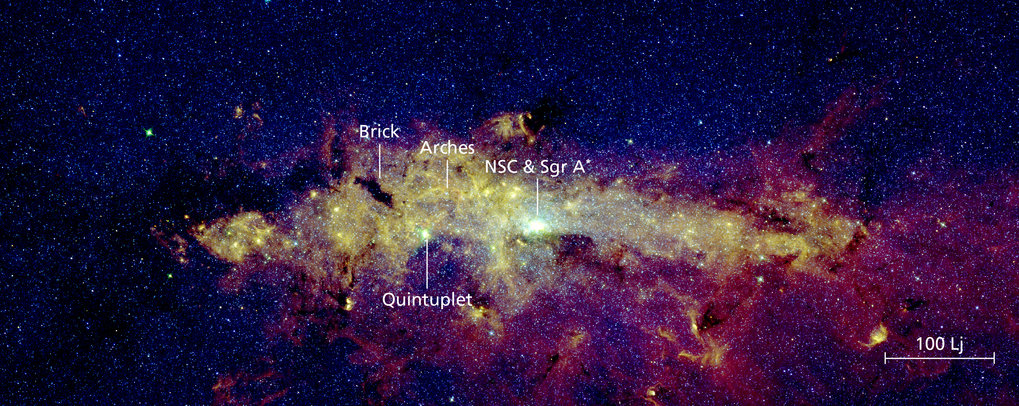
This image is a three-color combination image of CMZ, highlighting some unique features. Explains the location of some of the largest galaxies in the Milky Way, such as the Nuclear Star Cluster (NSC), the Arches, and the Quintuplets Cluster. “Brick” is a dark cloud that absorbs light, which appears as a photograph in front of a light background.
© Henshaw / MPIA
Stars form within dense zones in gas and dust clouds. Generally, if the cloud is dense enough, stars will appear at some point. However, this rule does not seem to apply entirely to the area around the center of the Milky Way. Central Molecular Zone (CMZ, English) Central Molecular Zone), A gas complex 1000 to 2000 light-years in diameter around the galaxy, containing the dense and largest gas clouds known in the Milky Way. However, with the exception of a few exceptionally large star clusters, many of these clouds show surprisingly small sources of widespread star formation.
To investigate this apparent discrepancy, a team led by Jonathan Henshaw of the Max Planck Institute for Astronomy (MBIA) in Heidelberg explored one of the most intriguing clouds in CMZ – the so-called “brick”. It is known for its high density and mass equivalent to about 100,000 suns. Nevertheless, it produces relatively few stars.
“When examining the gas movement in a brick, one component stands out in particular,” says Henshaw. He is the primary author of the basic article Monthly Announcements of the Royal Astronomical Society Has been published. “This structure, which is confined to a narrow speed range, resembles a crescent-shaped curve,” the researcher added.

The curve (thick black line) is a crescent-shaped structure of “brick”, a dense and massive gas and dust cloud within the central molecular zone. The origin of the curve is the envelope that expands around the hot gas bubble. The wind of the embedded massive star drives the expansion of this bubble.
© Image: Henshaw / MPIA
Such curves are found in areas where massive stars form and may refer to the material being carried through the expanding envelope of gas. Massive stars give energy and velocity to their surroundings, which act as the driving force of expansion. Based on this assumption, the research team determined that the diameter of the shell was 8.5 light years and the rate of expansion at five kilometers per second. By tracing this motion to its origin, astronomers date the beginning of expansion to a few million years ago. In view of the general time scales of cosmic events, this is only a blink of an eye.
Interestingly, Jonathan Henshaw and his colleagues discovered the emission of ionized gas, which corresponded to the cavity within the curve. This gas, detected by radio emissions, has a velocity corresponding to the motion of the curve – indicating a direct relationship between hot ionization and cold molecular gases.
Henshaw said, “We studied several possible scenarios of curvature expansion, and continued:” When we compare theoretical predictions with our observations, we find that the wind from a star is 20 times larger than the sun. Is likely to be a dominant mechanism. “
Overall, a more plausible explanation for the appearance of the curve is the idea of an expanding bubble of hot gas pumped by air from a large star formed within the brick. This result puts the seemingly inactive brick in a whole new light. Massive stars rarely wake up in solitude. They are usually a sign of the presence of a whole bunch of young stars of different masses. If this is the case with the brick, it may be more active than previously thought.
To estimate the mass of the suspected galaxy, astronomers simulated 10,000 galaxies. Statistical analysis of clusters with the largest stars 16 to 20 times the mass of the Sun indicates cluster masses between 400 and 700 solar masses. With the tools currently available, the authors of the basic research paper have demonstrated that such clusters can be easily obscured by the confusion of many stars seen towards the center of the galaxy and by the gas and dust between these stars.
To better identify the stars within the brick, astronomers are anticipating the James Webb Space Telescope, which is scheduled to be launched into space in 2021. His results will help determine the star clusters in the brick and determine the cause of the formation of the bow.
Background information
In this group J.D. Henshaw (Max Blanc Institute for Astronomy, Heidelberg, Germany [MPIA]), MR Krumholz (MPIA; Australian National University, Canberra, Australien; ARC Center of Excellence for Three Dimensions, Canberra, Australien; ZAH, Universität Heidelberg, Deutschland), NO Butterfield (Villanova University, USA), J. Dublin Institute for Advanced Studies, Ireland), a. Ginsburg (University of Florida, Keynesville, USA [UFL]), TJ Haworth (Queen Mary University of London, UK), F. Noguros-Laura (MPIA), AT Barnes (Universität Bonn, Deutschland), SN Longmore (John Moores University, Liverpool, UK), J. Polly (University of Colorado, USA), JMT Grousen (ARI, University of Heidelberg, Deutschland), EAC Mills (University of Kansas, Lawrence, USA), h. Futur (MBIA), DL Walker (University of Connecticut, Stores, USA). [UCONN]), C. Battersby (UCONN), A. Bulatek (UFL), T. Henning (MPIA), J. Ott (National Radio Astronomy Observatory, Socorro, USA; New Mexico Institute of Mining and Technology, Socorro, USA) and JD Solar (MPIA; Institute for Space Astronomy and Astronomy, National Institute of Astronomy, Roma, Italian).
M.N.

Edward Langley is a contributor to Nintendo-power.com, covering a wide range of topics including news, business, technology, entertainment, lifestyle and current affairs. He focuses on delivering clear, balanced and accessible reporting that helps readers stay informed about important developments and emerging trends. With an emphasis on accuracy, relevance and useful insights, Edward aims to provide engaging stories and practical information that matter to audiences in the UK and beyond.